
From Sphagnum Moss to Drones and Snowshoes: Local Climate Action Comes to Life in the Langenhausen Moor

Taking a Closer Look at the Zukunft Moor Project with First Climate Managing Director, Dr. Susanne Peindl
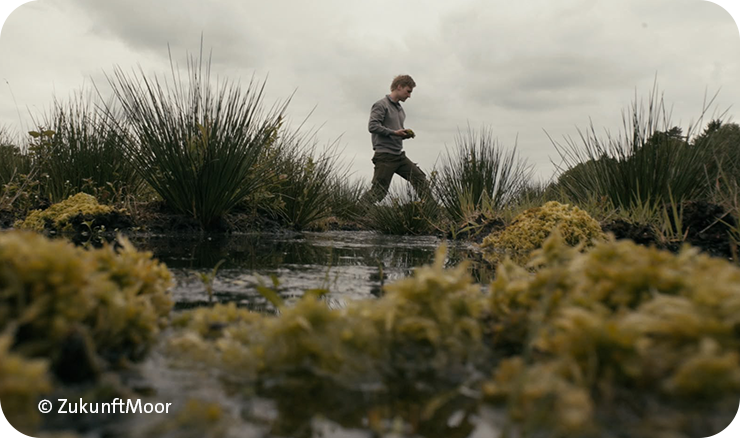
If you want to experience climate action in a peatland, sturdy boots are a must. Sometimes, even snowshoes. That’s one of the lessons my colleagues and I learned during our recent visit to our friends at ZukunftMoor in Gnarrenburg, Germany. Thanks to their restoration work, the Langenhausen Moor in Lower Saxony has been restored to its natural wet state once again – just as a healthy peatland should be. Areas that once released vast amounts of stored carbon due to drainage are gradually being transformed back into thriving, water-rich ecosystems with significant climate benefits. We visited the site to see firsthand how peatland restoration works, what technologies are used, and why working in these unique landscapes is both challenging and fascinating. It was climate action you can truly experience up close!
The ground beneath our feet is soft and saturated, and every step leaves a deep footprint. “That’s exactly what makes working here so unique,” Julia, Managing Director of ZukunftMoor, explains. “Every movement on the site has to be carefully considered, and every technical solution we use must be adapted to the peatland environment. Heavy machinery is rarely an option on such soft ground – because it could cause irreversible damage to this sensitive ecosystem.”
That’s why peatland restoration depends on smart, innovative solutions.
Why the Peatland Needs Water Again
Peatlands are among the world’s most effective natural carbon sinks. As long as they remain wet, the carbon stored in their peat stays largely locked away. But when peatlands are drained, oxygen reaches the peat layer, triggering decomposition. What was once a carbon store becomes a source of climate-warming emissions.
This is exactly what has happened across large areas of Germany. For centuries, many peatlands were drained to make them suitable for agriculture. Today, however, we know that rewetting these landscapes is one of the most powerful tools available for climate action.
To make that happen, the ZukunftMoor team blocks drainage channels, builds polders and water reservoirs, and carefully manages water levels to restore year-round saturation at the soil surface. While that may sound highly technical, the results on the ground are remarkably tangible: restored waterways, a pond-like retention basin, and an earthen berm encircling the project area and helping keep water where it belongs.
Pictures 1, 3-9: ©ZukunftMoor / Pictures 2, 10: ©Kristina Steiner
Where Sphagnum Meets Technology
A key component of the ZukunftMoor project is the cultivation of sphagnum moss through a practice known as paludiculture – the agricultural use of wet peatlands. Specialized farming methods make it possible to cultivate these waterlogged soils without further degrading the peat itself. Once harvested, the sphagnum can be processed and used by the growing soil industry as a valuable peat alternative.
On site, sphagnum moss is everywhere: covering fields in carpets of pale green, packed in large bags, and being sown in long rows across prepared peat surfaces. It may look delicate, soft, and lightweight, but it plays a vital role in the project. Sphagnum helps stabilize peat soils, supports new peat formation, and can make rewetted peatlands economically viable over the long term.
Pictures 2, 3, 4, 7: ©ZukunftMoor / Pictures 1, 4, 6: ©Kristina Steiner
To deliver the moss exactly where it is needed, ZukunftMoor relies on an uncomment helpmate: a heavy-lift drone. The drone transports planting material across the site while minimizing disturbance to sensitive areas. Watching the high-tech aircraft humming above the peatland is a striking sight—and a perfect illustration of how this project works: grounded in respect for nature, yet fully embracing innovative solutions.
Snowshoes in the Peatland
Not every activity can be done from the air. Much of the work takes place directly in the field, where conditions are very different from those on a typical farm.

To move across the soft, water-drenched ground, the ZukunftMoor team often relies on snowshoes. “It’s actually a very simple and practical solution,” Julia explains. “They distribute your weight more evenly, so you don’t sink as deeply into the peat and the sensitive surface is better protected – much like using snowshoes on a winter hike.”
A Specialized Vehicle for Harvesting Sphagnum
Harvesting sphagnum moss also requires specialized equipment. That’s why ZukunftMoor uses a compact tracked vehicle developed specifically for working on wet terrain while minimizing disturbance to the site.

This, too, reflects the unique character of the project. On one hand, it is built around one of the oldest nature-based climate solutions imaginable: a healthy, waterlogged peatland. On the other, it relies on drones, purpose-built machinery, modern water and land management techniques, and a young, highly motivated team determined to turn an ambitious vision into reality.
The result is a project that uniquely combines climate action, biodiversity conservation, water management, and local economic value creation. Our visit left us inspired once again by what is possible when innovation and nature work hand in hand.

Certified Climate Action in Germany: Our Partnership with ZukunftMoor
Peatlands play a vital role in climate action. At the Langenhausen Moor, ZukunftMoor is demonstrating how this natural climate solution can be revitalized through innovative approaches and modern technology. Likewise, the project delivers a range of additional benefits: the restored peatland can retain more water, peatland-specific plants and wildlife can return, and a new model of sustainable, peat-preserving agriculture is taking shape.
The ZukunftMoor project is one of only a handful of certified climate action projects taking place in Germany. It shows that nature-based solutions do not have to be abstract concepts or faraway initiatives. They can be implemented right here, close to home, generating measurable climate benefits while strengthening local ecosystems and communities. We are proud that, together with our clients, the First Climate team can help support and advance this remarkable project.
Learn more about the ZukunftMoor project and how you can support it:
The author

Dr. Susanne Peindl
Managing Director
First Climate Markets GmbH

